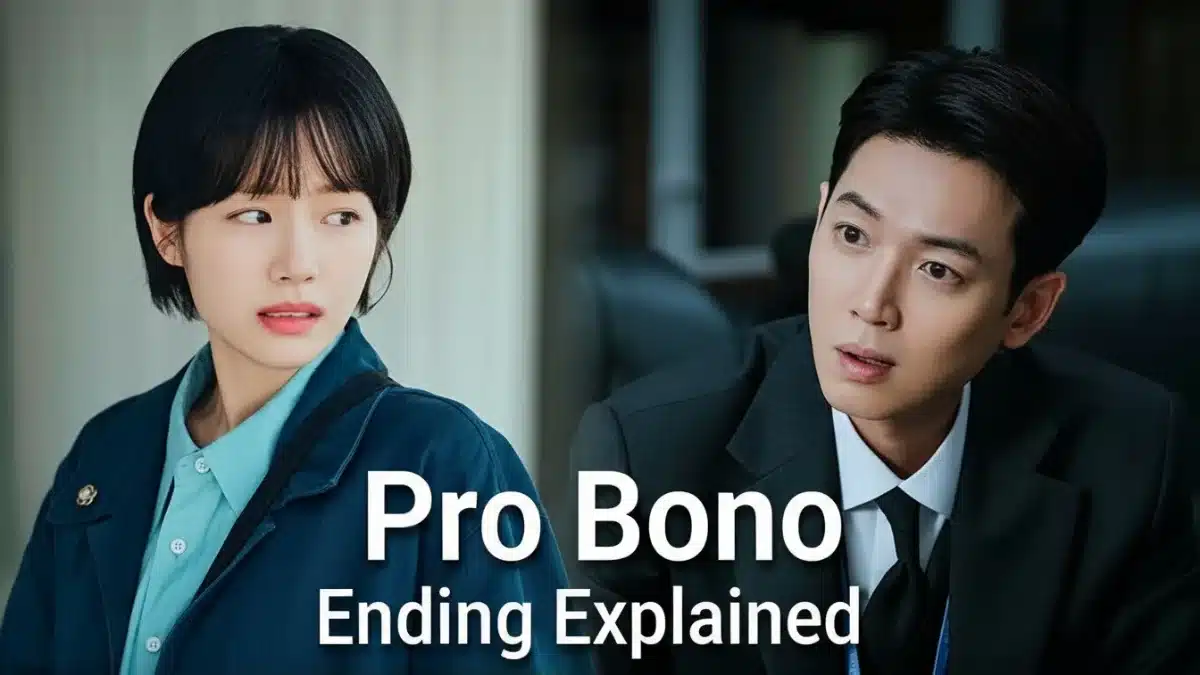
🚨 MAJOR SPOILER WARNING 🚨
This article contains complete spoilers for the finale of Pro Bono, including the resolution of the final case, Min Jae-in and Lee Da-kyung’s relationship outcome, and the symbolic meaning of the closing scenes. If you haven’t finished the series, please watch it first or read the Pro Bono Full Recap for a comprehensive overview before diving into this ending analysis.
You’ve been warned. Let’s unpack one of the most thought-provoking legal drama finales in recent K-Drama history.
Table of Contents
Introduction: When the Verdict Changes Everything
The finale of Pro Bono didn’t just close a legal case—it fundamentally redefined what justice means in a system designed to favor those with power and money. Over 16 episodes, we watched Min Jae-in (Lee Do-hyun) transform from a cynical, emotionally detached legal machine into someone willing to risk everything for what’s right. We saw Lee Da-kyung (Kim Se-jeong) evolve from idealistic rookie to strategic fighter who understands that changing the system requires working within it, even as you challenge it.
The final case—the one that brings everything full circle—isn’t just another pro bono assignment. It’s the test of whether Jae-in and Da-kyung can build something lasting from the wreckage of a broken justice system. It’s about whether caring too much will destroy them or save them.
Unlike the devastating moral complexity explored in The Price of Confession Recap, where confession itself becomes a weapon, Pro Bono asks a different question: What happens when winning in court isn’t enough? When even victory feels like defeat because the system itself is corrupt?
The answer the finale provides is both hopeful and brutally realistic—exactly what makes this ending so powerful.
The Final Case: The Kang Industries Whistleblower Scandal
The Setup: Episodes 13-14
The final case that dominates the last four episodes involves Oh Soo-jin, a mid-level executive at Kang Industries who discovered that the company has been systematically dumping toxic waste in a rural community for over a decade. The contamination has caused cancer clusters, birth defects, and environmental devastation affecting over 3,000 residents.
The Complication: Kang Industries is represented by Hanul & Associates—Jae-in and Da-kyung’s own firm. Senior Partner Jung Yeon-su assigns the firm’s top corporate team to defend Kang Industries while simultaneously allowing Jae-in and Da-kyung to represent the whistleblower and affected residents pro bono.
The Impossible Situation: Jae-in and Da-kyung are literally fighting against their own firm. Every strategy they develop, the corporate defense team can anticipate because they share the same resources, training, and institutional knowledge. It’s a rigged game from the start.
Episode 14’s Devastating Twist: Da-kyung discovers that one of the senior partners on the Kang Industries defense team is her former law school mentor, Professor Ahn Min-hyuk, who once inspired her to pursue public interest law. He’s now using every tactic she taught him about justice to defend corporate malfeasance.
The betrayal is personal and professional. And it forces Da-kyung to confront an uncomfortable truth: good people can do terrible things when the incentives are strong enough.
The Trial: Episodes 15-16
The Stakes: If Jae-in and Da-kyung lose, the residents get nothing, Kang Industries continues operations, and Oh Soo-jin faces criminal charges for violating her NDA. If they win, they expose their own firm’s complicity in defending corporate crimes—potentially destroying their careers.
Episode 15’s Turning Point:
During cross-examination, Professor Ahn systematically destroys Oh Soo-jin’s credibility, painting her as a disgruntled employee seeking attention and money. The courtroom technique is flawless, ethical within the bounds of legal practice, and utterly devastating.
Jae-in watches his partner crumble under the assault and does something he’s never done before: he asks for a recess and walks out of the courtroom mid-trial.
Da-kyung finds him in the courthouse bathroom, having a panic attack similar to the one she witnessed back in episode 5. But this time, the panic isn’t about failure—it’s about clarity. Jae-in finally understands what Da-kyung has known all along: winning isn’t enough if the system itself is broken.
Jae-in’s Decision:
He returns to the courtroom and does the unthinkable. Instead of continuing to argue within the narrow confines of the legal case, he expands his argument to challenge the entire framework of corporate accountability.
His closing argument (which takes up nearly 15 minutes of screen time in episode 16) is a masterpiece:
“Your Honor, we’ve spent three weeks debating whether Kang Industries knowingly violated environmental regulations. But that’s not really what this case is about. This case is about a system that makes it more profitable to poison communities than to follow the law. A system where a company can budget for legal fees and settlements as a cost of doing business rather than actually changing their practices.
My client, Oh Soo-jin, didn’t come forward because she wanted money. She came forward because she has a conscience. And the fact that having a conscience makes her the criminal in this scenario—while executives who knowingly endangered thousands of lives walk free—tells you everything you need to know about how broken this system is.
I’m not just asking you to rule in favor of the plaintiffs. I’m asking you to send a message that corporations cannot buy their way out of accountability. That pro bono isn’t charity—it’s justice. And justice can’t be a luxury only the wealthy can afford.”
The Verdict: Episode 16’s Climax
The judge rules in favor of the residents.
Kang Industries is ordered to:
- Pay full medical compensation to all affected residents
- Fund comprehensive environmental remediation (estimated at ₩500 billion)
- Face criminal investigation for willful environmental negligence
- Establish a community health monitoring program for 20 years
But here’s the gut-punch: The judge also issues a scathing supplementary opinion criticizing Hanul & Associates for the ethical conflict of representing both sides of such a consequential case. The firm faces regulatory investigation, potential sanctions, and massive reputational damage.
Jae-in and Da-kyung won the case—and destroyed their own careers in the process.
The Aftermath: Episodes 16’s Final 30 Minutes
The Firm’s Response
Senior Partner Jung Yeon-su summons Jae-in and Da-kyung to her office. The scene is tense, quiet, and more devastating than any screaming match could be.
Jung: “You’ve won your case. Congratulations. You’ve also cost this firm our largest client, triggered an ethics investigation, and made it impossible for us to continue operating the way we have for 30 years.”
Jae-in: “Then maybe it’s time the firm operated differently.”
Jung: “Or maybe it’s time you operated somewhere else.”
They’re not fired—they’re offered a choice: Stay at Hanul & Associates, return to corporate work, and pretend the past year never happened. Or leave voluntarily with a generous severance package and non-disparagement agreements.
Da-kyung’s response is immediate: “I’ll take the severance.”
Jae-in’s response surprises everyone, including himself: “So will I.”
The Six-Month Time Jump
The drama jumps forward six months. This narrative choice is deliberate—it shows us that the immediate aftermath wasn’t glamorous or triumphant. It was hard, uncertain, and messy.
What we learn through careful visual storytelling:
Min Jae-in:
- Has been working with a legal aid organization, taking exclusively pro bono cases
- Lives in a much smaller apartment (his penthouse is gone)
- Looks tired but genuinely peaceful in a way we’ve never seen before
- Still has nightmares, still takes sleeping pills, but now he talks about it in therapy (we see a therapist’s appointment reminder on his phone)
Lee Da-kyung:
- Joined the same legal aid organization
- Has reconnected with her family (we see photos with her younger brother on her desk)
- Teaches a weekly class on public interest law at her former law school
- Looks exhausted but fulfilled
They’re working together again—but now on their own terms, in a system that actually values what they’re trying to do.
The Final Scene: Redefining “Pro Bono”
The New Beginning
The camera follows Jae-in and Da-kyung as they arrive at a modest office building in a working-class neighborhood. The sign outside reads: “Second Foundation Legal Services: Justice for Those Who Need It Most”
Inside, we see:
- A waiting room filled with clients (elderly residents, migrant workers, small business owners)
- Two young lawyers working at desks (former Hanul & Associates junior associates who quit to join them)
- Paralegal Choi Min-ji organizing files and answering phones
- Hwang Gi-taek, the exonerated man from episodes 9-12, volunteering as an intake coordinator
The symbolism of “Second Foundation”:
- References Jae-in’s architecture background (building new structures on stronger foundations)
- Acknowledges this is a “second chance” for both of them
- Implies they’re laying the groundwork for systemic change, not just individual cases
The Romantic Resolution (Or Is It?)
Unlike typical K-Drama finales that end with dramatic kisses or wedding scenes, Pro Bono keeps the romance understated and realistic.
The Scene:
Jae-in and Da-kyung are alone in the office after everyone else has left. They’re reviewing case files for the next day, sitting at the same desk, shoulders nearly touching.
Da-kyung (without looking up): “Do you ever regret it? Leaving Hanul?”
Jae-in: “Every time I look at my bank account.”
Da-kyung laughs: “That’s not an answer.”
Jae-in: “No. I don’t regret it. Do you?”
Da-kyung: “Not even a little bit.”
Then comes the moment that defines their relationship:
Jae-in closes the case file he’s reading and turns to look at her directly: “I should tell you something. For full disclosure.”
Da-kyung finally looks up, recognizing the phrase she used when she confessed her feelings in episode 13: “Oh no. Are you about to say something emotionally vulnerable? Should I record this?”
Jae-in (actually smiling): “I’m in love with you. Have been for months. Just thought you should know.”
Da-kyung: “I know.”
Jae-in: “That’s it? Just ‘I know’?”
Da-kyung: “What do you want me to say? I told you six months ago. I’ve been waiting for you to catch up.”
Jae-in: “So… what now?”
Da-kyung: “Now? Now we finish reviewing these files because Mrs. Kim’s hearing is tomorrow morning and we need to be prepared.”
Jae-in: “That’s your response to a love confession?”
Da-kyung (grinning): “What did you expect? We work together, Jae-in. We see each other 12 hours a day. We’re building something important here. The romance is just… the bonus.”
Jae-in reaches over and takes her hand: “Some bonus.”
Da-kyung interlaces their fingers: “Some bonus indeed.”
They return to reading case files—but now they’re holding hands while doing it.
The Final Shot
The camera pulls back slowly, showing:
- Jae-in and Da-kyung working side by side, hands still linked
- The office walls covered with photos of clients they’ve helped
- A framed copy of Hwang Gi-taek’s exoneration ruling
- Case files stacked everywhere (they’re clearly overwhelmed with demand)
- Through the window, Seoul’s skyline—Hanul & Associates’ gleaming tower visible in the distance
The final line of dialogue:
Da-kyung: “Do you think we can actually change things? Make the system better?”
Jae-in: “Probably not. Not the whole system, anyway.”
Da-kyung: “So why are we doing this?”
Jae-in: “Because the system won’t change if no one tries. And because…” (he squeezes her hand) “…I don’t want to do this with anyone else.”
Da-kyung smiles: “Good answer.”
The screen fades to white (not black), and the final text appears:
“In Korea, over 80% of civil cases involve at least one party without legal representation.
Organizations like Second Foundation Legal Services make justice possible for those who cannot afford it.
Pro bono isn’t charity. It’s how the law is supposed to work.”
The credits roll over footage of real Korean legal aid lawyers working with actual clients (with faces blurred for privacy). It’s a powerful reminder that the story we just watched is fictional, but the need is very real.
YouTube Video Section: Pro Bono Finale Emotional Highlights
If you haven’t already watched the final scene, find it on YouTube immediately. Lee Do-hyun and Kim Se-jeong deliver performances so nuanced and understated that you need to watch their microexpressions to catch the full emotional weight.
The hand-holding moment—so simple on paper—becomes devastating when you remember these are two people who’ve spent 16 episodes learning to trust again, to care again, to hope again. The way Jae-in’s hand trembles slightly before Da-kyung steadies it with her own? That’s not in the script—that’s two actors who completely understand their characters’ journeys.
Watch for the moment around the 3:45 mark when Jae-in looks at the case files and then at Da-kyung, and you can literally see him thinking: “This is what happiness looks like.” It destroys you in the best possible way.
Vani’s Deep-Dive Analysis: The Philosophy of Justice vs. Law
The Central Theme: What Did “Pro Bono” Really Mean?
Throughout the series, the title Pro Bono (Latin for “for the public good”) operated on multiple levels:
Literal Meaning: Legal work done without payment for clients who cannot afford representation.
Thematic Meaning: The question of what we owe to each other as members of a society. Who is responsible for ensuring justice is accessible?
Character Arc Meaning: For Jae-in, “pro bono” was initially an obligation—something required but resented. By the finale, it becomes his purpose. He’s not doing this work “for free”—he’s doing it because this is the only work that makes him feel like himself again.
Societal Meaning: The drama argues that pro bono shouldn’t exist as a separate category of legal work. Justice shouldn’t be something only the wealthy can afford. The entire system needs restructuring.
Comparing Endings: Pro Bono vs. Other 2025 Dramas
Unlike the gentle, hopeful resolution detailed in Surely Tomorrow Ending Explained, where healing was personal and the characters found peace in small-town life, Pro Bono ends with a battle cry. Jae-in and Da-kyung aren’t retreating from the world—they’re charging back into it with clearer purpose.
Similarly, while The Price of Confession Ending Explained explored how truth can be both liberating and destructive, Pro Bono suggests that some truths must be spoken regardless of personal cost. The difference is that Jae-in and Da-kyung choose their sacrifice—they’re not cornered into confession but willingly expose their firm’s corruption.
Where Pro Bono stands in Best K-Dramas of 2025 Recommendations: This ending cements Pro Bono as one of the year’s most important dramas. It’s not the most emotionally cathartic (that honor goes to Surely Tomorrow) or the most shocking (see The Price of Confession), but it’s the most ideologically coherent. Every narrative choice serves the central thesis about justice, access, and institutional change.
The Symbolism of the Final Shot
The Hand-Holding: Not romantic in a traditional sense—it represents partnership, mutual support, shared burden. They’re holding hands the way teammates clasp hands before a big game. It’s intimacy built on respect and shared mission.
The Office Location: They deliberately chose a working-class neighborhood rather than the prestigious Gangnam district where Hanul & Associates operates. Geography is destiny in Seoul’s stratified society, and this choice signals whose side they’re on.
The Visible Hanul Tower: The drama doesn’t let them forget where they came from. The tower in the distance is a reminder that corporate law firms still exist, still wield enormous power, and still need to be challenged. This isn’t a “happily ever after” where the villains disappear—it’s a realistic ending where the fight continues.
The White Fade (Not Black): Most dramas fade to black, suggesting closure or ending. The white fade suggests possibility, new beginning, blank page ready to be written. It’s hopeful without being naïve.
What the Ending Says About Real-World Justice
The drama’s decision to include real footage of legal aid lawyers in the credits is crucial. It bridges the gap between fiction and reality, reminding viewers that:
- Access to justice is a real crisis in Korea and globally
- Legal aid organizations are chronically underfunded despite doing essential work
- Individual lawyers making ethical choices matter, even if they can’t change the entire system alone
- Pro bono work shouldn’t be exceptional—it should be the baseline expectation
Character Resolutions: Where Everyone Ends Up
Min Jae-in’s Completed Arc
Where he started: Cynical, emotionally unavailable, brilliant but hollow, working exclusively for wealthy clients while doing token pro bono work.
Where he ends: Still cynical (realism, not pessimism), emotionally open with Da-kyung, brilliant and purposeful, working exclusively on cases that matter even though they pay nothing.
What didn’t change: He still has nightmares. He still takes sleeping pills. He still struggles with the guilt from Hwang Gi-taek’s case. And that’s important. The drama doesn’t pretend that trauma disappears when you find purpose. Jae-in is healing, but he’s not healed—and he may never be fully healed. He’s just learning to live with his scars while doing meaningful work.
The most important growth: He can now receive love. Early episodes showed Jae-in physically unable to accept comfort or vulnerability from others. The finale shows him holding Da-kyung’s hand naturally, almost unconsciously. That’s years of therapy and trust condensed into a simple gesture.
Lee Da-kyung’s Evolution
Where she started: Idealistic to the point of naivety, willing to fight but not always strategically, driven by personal trauma (her mother’s legal battle).
Where she ends: Still idealistic but strategically sophisticated, fighting smarter not just harder, driven by systemic understanding rather than just personal pain.
What didn’t change: Her fundamental belief that people deserve justice regardless of ability to pay. Her willingness to sacrifice financial security for principles. Her tendency to care too much (which Jae-in now recognizes as strength, not weakness).
The most important growth: She learned when to compromise and when to hold firm. Early Da-kyung saw every case in black and white. Final Da-kyung understands nuance, strategic retreat, and the long game of institutional change.
The Relationship: Why It Works
Jae-in and Da-kyung’s relationship succeeds because it’s built on:
- Mutual respect for professional competence (they’re both excellent lawyers)
- Complementary skills (his strategy + her empathy = complete approach)
- Shared mission (they want the same things for the same reasons)
- Honest communication (no manufactured misunderstandings or unnecessary drama)
- Patience (they let the relationship develop at its own pace)
Unlike romance dramas where the relationship IS the plot, in Pro Bono the relationship is the REWARD for character growth. They couldn’t have built this partnership without first becoming better versions of themselves individually.
The Supporting Cast: Final Moments
Senior Partner Jung Yeon-su
The drama’s most morally complex character gets a nuanced ending. She’s not revealed as secretly evil—she genuinely believed that a firm could do both profitable corporate work and meaningful pro bono cases. The finale shows her reevaluating that belief.
Her final scene (easily missed): Episode 16, during the credits sequence, we briefly see Jung in her office late at night, reviewing the ethics investigation documents. She picks up the phone and makes a call (we don’t hear the conversation), but the implication is clear: she’s considering fundamental changes to how Hanul operates.
It’s not redemption—it’s the beginning of awareness. And sometimes that’s all you can ask for.
Paralegal Choi Min-ji
Joins Second Foundation Legal Services, taking a significant pay cut to do so. Her final line to Jae-in: “I didn’t go to law school, so I can’t argue cases. But I can make sure the lawyers who do have everything they need. That’s worth something, right?”
Jae-in’s response: “That’s worth everything.”
Professor Ahn Min-hyuk (Da-kyung’s Former Mentor)
Remains at Hanul Associates defending corporate clients. The drama doesn’t villainize him—it simply shows that good people make different ethical calculations. His final interaction with Da-kyung is a brief hallway encounter where he says: “I hope you’re right about this. I really do.”
It’s a small moment of doubt that suggests even those still in the system are questioning it.
Hwang Gi-taek (The Exonerated Client)
His presence at Second Foundation as a volunteer is deeply meaningful. He’s not just a client who was helped—he’s now part of the solution, using his experience to help others navigate the legal system. It’s the drama’s clearest statement about community-based justice.
Unanswered Questions & Future Possibilities
Will Second Foundation Survive Financially?
The drama doesn’t sugarcoat the economics. Legal aid organizations struggle constantly with funding. The final scene shows the office is modest, resources are limited, and they’re clearly working more cases than they can handle sustainably.
But the drama implies survival through community: We see donation boxes, pro bono support from other lawyers, and clients who contribute what they can (one elderly woman brings homemade food instead of payment).
What Happens to Hanul & Associates?
The ethics investigation is ongoing. Jung Yeon-su is reevaluating the firm’s model. But institutional change is slow, and the drama doesn’t pretend one lawsuit will topple the corporate legal establishment.
Is There a Season 2?
While not officially announced, the ending leaves room for continuation. There are hundreds of cases to fight, systemic issues to tackle, and the ongoing question of whether Second Foundation can scale their model or if they’ll always be a small organization doing what they can.
Personally, I hope they leave it as is. This ending is perfect—hopeful but realistic, complete but not closed.
Thematic Deep Dive: The Questions Pro Bono Asks
Can Individual Ethics Change Systemic Problems?
The drama’s answer: Not by themselves, but they’re necessary. Jae-in and Da-kyung leaving Hanul doesn’t destroy the corporate legal establishment. But it creates an alternative model. It shows other lawyers that different approaches are possible. It plants seeds.
Is “Pro Bono” Enough?
The drama’s answer: No. Pro bono work within a fundamentally unjust system is a band-aid on a bullet wound. Real change requires systemic reform—better legal aid funding, stronger regulations, cultural shift in how society values justice vs. profit.
But until that systemic change happens, pro bono work keeps people alive, keeps families together, keeps hope possible.
What Do We Owe Each Other?
The drama’s ultimate question: In a society structured around individual competition and corporate profit, what are our obligations to people we’ll never meet? To communities we’re not part of? To a collective good that may not benefit us personally?
Jae-in and Da-kyung’s answer: Everything. We owe each other everything.
Comparing Legal Drama Endings: How Does Pro Bono Rank?
Against Extraordinary Attorney Woo (2022)
Attorney Woo ended with the protagonist finding acceptance and continuing at her firm. It was heartwarming and focused on individual triumph over discrimination.
Pro Bono ends with systemic critique—it’s not enough to succeed within a broken system; you must work to change the system itself. More radical, less comforting.
Against Stranger/Secret Forest (2017, 2020)
Stranger ended both seasons with qualified victories—corruption exposed but not eliminated. Similar to Pro Bono in its realism about institutional change.
The difference: Stranger focused on prosecutors and police. Pro Bono focuses on civil law and access to justice, making it more immediately relevant to ordinary people’s lives.
Against Lawless Lawyer (2018)
Lawless Lawyer ended with the villain defeated and justice triumphant. Satisfying but unrealistic.
Pro Bono rejects the “defeat the villain, fix the system” narrative. There’s no single villain—the system itself is the antagonist, and you can’t defeat it, only push back against it, case by case.
The Cultural Context: Why This Ending Matters in Korea
Legal Aid in Korea: The Reality
Korea’s legal aid system is chronically underfunded. According to 2024 statistics (referenced in the drama’s credits):
- Over 80% of civil cases involve at least one unrepresented party
- Legal aid organizations serve less than 15% of those who qualify for assistance
- Many cases that should be fought are simply abandoned because lawyers are unavailable
The drama’s impact: By showing this reality through compelling characters and real cases, Pro Bono has sparked actual conversations about legal aid reform in Korean media and policy circles.
The “Success at Any Cost” Culture
Korean society (like many others) often measures success by wealth, prestige, and status. Jae-in’s decision to leave a prestigious firm for low-paying public interest work is countercultural.
The drama’s message: There are different kinds of success. Purpose matters more than prestige. Impact matters more than income.
This resonates particularly with younger Korean viewers who are increasingly questioning traditional success metrics.
What to Watch Next: For Fans of Pro Bono
If you loved the social justice themes and complex ethics of Pro Bono, here’s what to add to your queue:
Similar Legal/Social Justice Themes:
- Juvenile Justice (2022) – Judges handling youth crime cases
- Stranger (2017, 2020) – Prosecutors fighting corruption
- Law School (2021) – Law students grappling with justice vs. law
For More Lee Do-hyun:
- The Good Bad Mother (2023) – Different genre but shows his range
- Youth of May (2021) – Historical romance drama
For More Kim Se-jeong:
- Business Proposal (2022) – For her rom-com energy
- The Uncanny Counter (2020-2023) – For her action/fantasy range
What’s Coming Next: If you need something new while processing your Pro Bono emotions, check out Netflix K-Dramas January 2026 for upcoming releases including Can This Love Be Translated? and other exciting titles!
For healing after this intense journey, consider the gentle romance of Surely Tomorrow Recap as a palate cleanser.
Final Verdict: Does the Ending Deliver?
Rating: 9.5/10
What Works: ✅ Ideologically consistent—every choice serves the central themes
✅ Realistic about limitations while maintaining hope
✅ Respects character development—no shortcuts or personality transplants
✅ Romance feels earned, not forced
✅ Addresses real social issues without being preachy
✅ Leaves you thinking about justice long after the credits roll
Minor Criticisms: ⚠️ Some viewers may want more explicit “victory” over the system
⚠️ The romance resolution is understated (might disappoint traditional rom-com fans)
⚠️ Doesn’t tie up every loose end (Jung Yeon-su’s arc, firm investigation outcome)
⚠️ The final message is inspiring but somewhat idealistic given real-world constraints
Bottom Line: Pro Bono delivers one of the most intellectually and emotionally satisfying legal drama endings in K-Drama history. It refuses easy answers while maintaining belief in human capacity for change. It honors its characters’ journeys while acknowledging that institutional change requires more than individual heroism.
This isn’t an ending that will make you cry tears of joy (though you might cry anyway). It’s an ending that will make you think, question, and maybe—just maybe—consider what justice means in your own life and community.
Conclusion: Justice Is a Practice, Not a Destination
The genius of the Pro Bono ending explained is captured in its final image: Jae-in and Da-kyung working side by side, case files piled high, hands linked, Hanul Tower visible in the distance.
They haven’t defeated the system. They haven’t even significantly dented it. What they’ve done is create an alternative—a small space where justice operates on different terms, where success is measured in lives changed rather than billable hours, where “pro bono” isn’t charity but the whole point.
Min Jae-in learned that caring doesn’t make you weak—it makes you human.
Lee Da-kyung learned that idealism without strategy accomplishes nothing.
Together, they learned that changing the world starts with changing how you practice law, one case at a time.
The drama ends not with victory but with commitment. And that’s the most honest, hopeful ending it could have given us.
Your Turn: The Verdict Is Yours
What did you think of Pro Bono‘s finale?
Drop your thoughts in the comments:
- ⚖️ Did the ending satisfy you, or did you want more dramatic resolution?
- 💼 Would you have made the same choice as Jae-in and Da-kyung to leave Hanul?
- 💕 Were you satisfied with the romantic resolution, or did you want more explicit scenes?
- 🤔 What case from the series hit you the hardest?
- 📺 How does this compare to other legal drama endings you’ve seen?
- 🌟 What do you think happens next for Second Foundation Legal Services?
And the big question: If you were a talented lawyer, would you choose the Hanul path (prestige, money, corporate clients) or the Second Foundation path (purpose, struggle, meaningful impact)?
Share this article with your fellow legal drama enthusiasts, and let’s discuss what justice really means!
More from the KDramaBite Team:
Our writers at KDramaBite are passionate about bringing you in-depth analysis that goes beyond surface-level recaps. We believe K-Dramas are powerful cultural texts that deserve serious critical engagement—and we’re committed to providing that for you, one drama at a time.

🔔 Subscribe to KDramaBite.com for more ending analyses, thematic deep dives, and discussions on how K-Dramas tackle social justice, mental health, and institutional change!